
 Íslenska
  English
 There can be plenty of nutrients in the pot or tank, yet the plant may still struggle to access them. Acidity may be one reason. It affects whether the roots can take up nutrients, even when those nutrients are present.
That is why adding more fertiliser is not always the answer. We also need to look at acidity, the roots and the conditions the plant is growing in. Here we explain what the pH number tells us, how to measure it and when there may be a reason to change it.
In brief
- pH tells you how acidic or alkaline a solution is. It does not tell you how much fertiliser it contains.
- The right acidity helps the plant access the nutrients that are present.
- Measure the water after the fertiliser has been mixed in thoroughly. Check the meter before reacting to an unexpected reading.
- Base your target on the plant and growing method. Don’t chase one exact number if the value is already within a suitable range.
- Daily measurement is not automatically necessary in a stable home-growing set-up. Measure more often while learning how the system behaves, and when conditions change or something seems wrong.
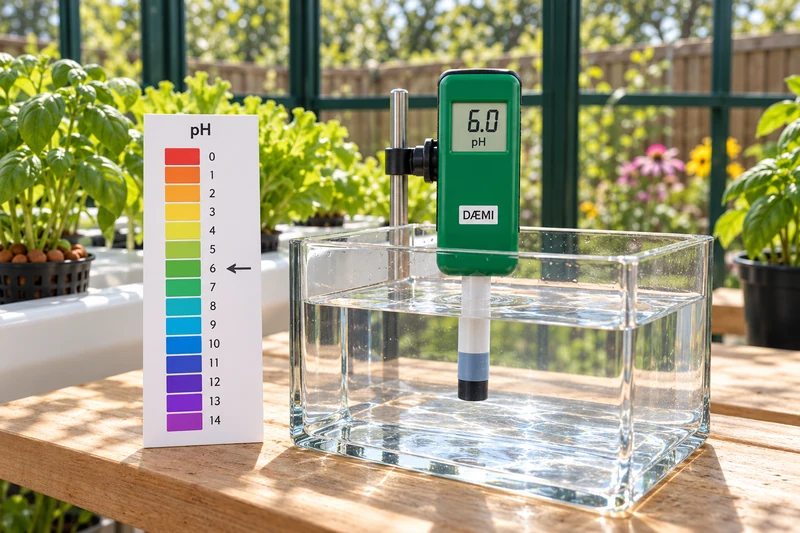
Image: RBHMMX · CC BY 4.0.
What does the pH value mean?
pH is a number that tells you how acidic water is. At ordinary room temperature, pH 7 is close to neutral. Below 7 it is acidic, and above 7 it is alkaline. Alkaline is simply the word for the other side of the scale. Water with fertiliser dissolved in it is called nutrient solution.
The difference between pH 7 and 6 is greater than the numbers may suggest. Each step down means a tenfold increase. Two steps down, from 7 to 5, therefore mean a hundredfold increase. What increases is the activity of tiny particles in the water called hydrogen ions, which are related to how acidic it is. You don’t need to know the chemistry to use the meter, but it is worth remembering that a difference of one number can matter a lot.
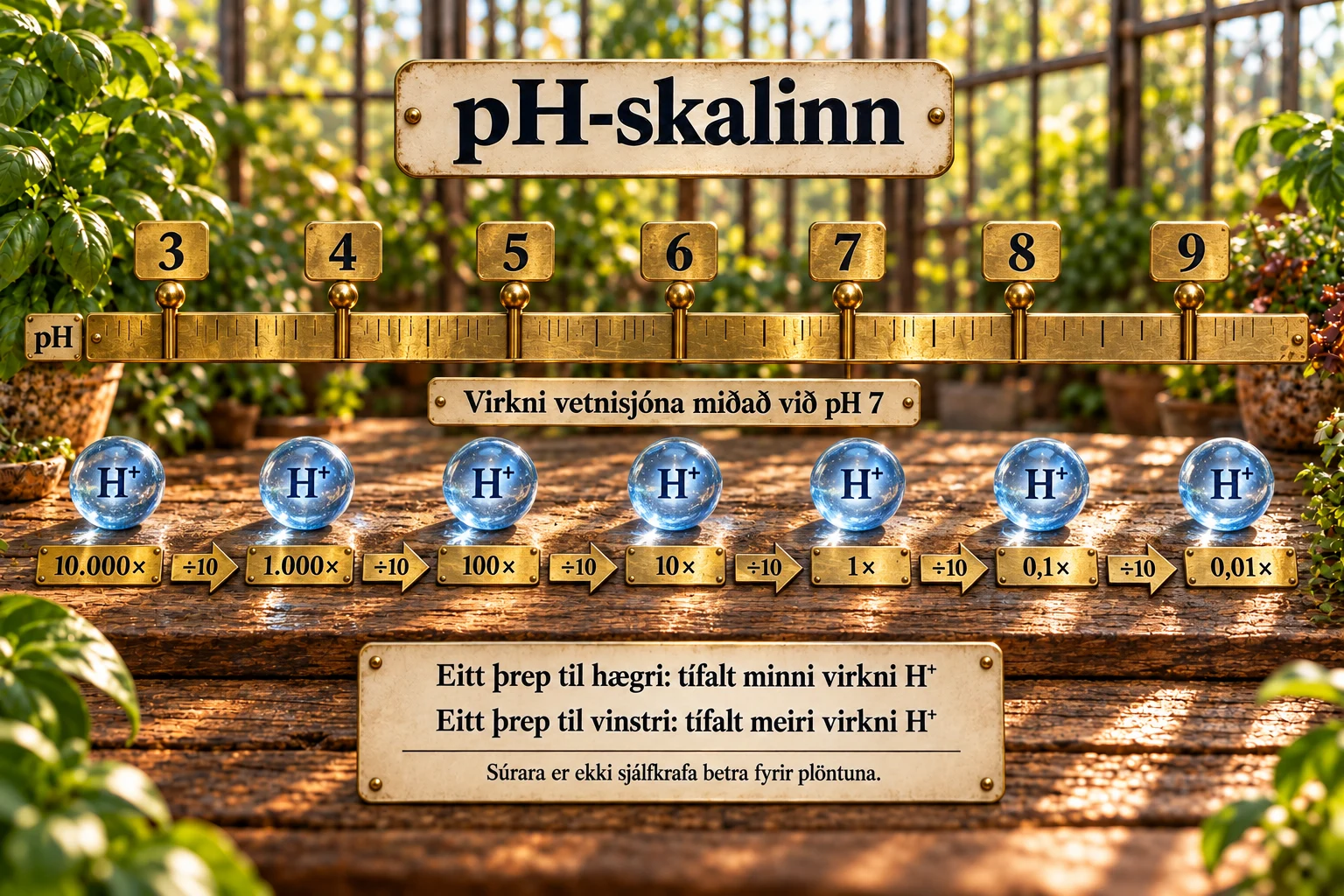
Diagram: RBHMMX · CC BY 4.0.
The pH 3–9 shown in the image is an example of part of the scale, not a recommended growing range. pH 3 is very acidic and pH 9 is alkaline; such conditions are generally unsuitable for most common crop plants. A suitable range depends on the species and growing method.
For the curious: tenfold changes, hydrogen ions and pH
A scale on which equal steps represent multiplication is called logarithmic. pH is the negative base-10 logarithm of hydrogen-ion activity: a decrease of one unit means tenfold activity. That is not the same as ten times as much acid to pour into the tank.
At about 25°C, pH 7 is neutral, but the neutral value changes with temperature. The scale is often shown from 0 to 14, although pH can also fall outside that range.
Precisely defined, pH is a dimensionless value based on the activity of hydrogen ions in a solution. Here, activity describes the ions’ chemical behaviour, not just their number.
A water molecule, H₂O, consists of two hydrogen atoms and one oxygen atom. Water molecules can pass a hydrogen ion between them. This forms H₃O⁺ and OH⁻, although only a small proportion of pure water is in this form at any one time.
In chemistry, H⁺ is often used as shorthand when discussing these hydrogen ions in water. At about 25°C, pure water is neutral, with a pH of about 7. Acids and bases change the ionic balance. This is the background to pH measurement, but when growing plants you mainly need to know the right range and use a reliable meter.
How does acidity affect nutrients?
Think, for example, of water that can be ice, liquid or vapour depending on the temperature. It is still water, but its form matters to how we can use it. Acidity and temperature are not the same thing, but the analogy helps explain that a nutrient can be present without being in a form the plant can easily access.
Nutrients can bind to other substances in the soil or form solids that dissolve poorly in water. The nutrients may still be present even though the roots cannot access them easily. At an unsuitable pH, a plant may struggle to take up some substances while taking up too much of others. That is why a nutrient deficiency does not always mean you need to add more fertiliser.
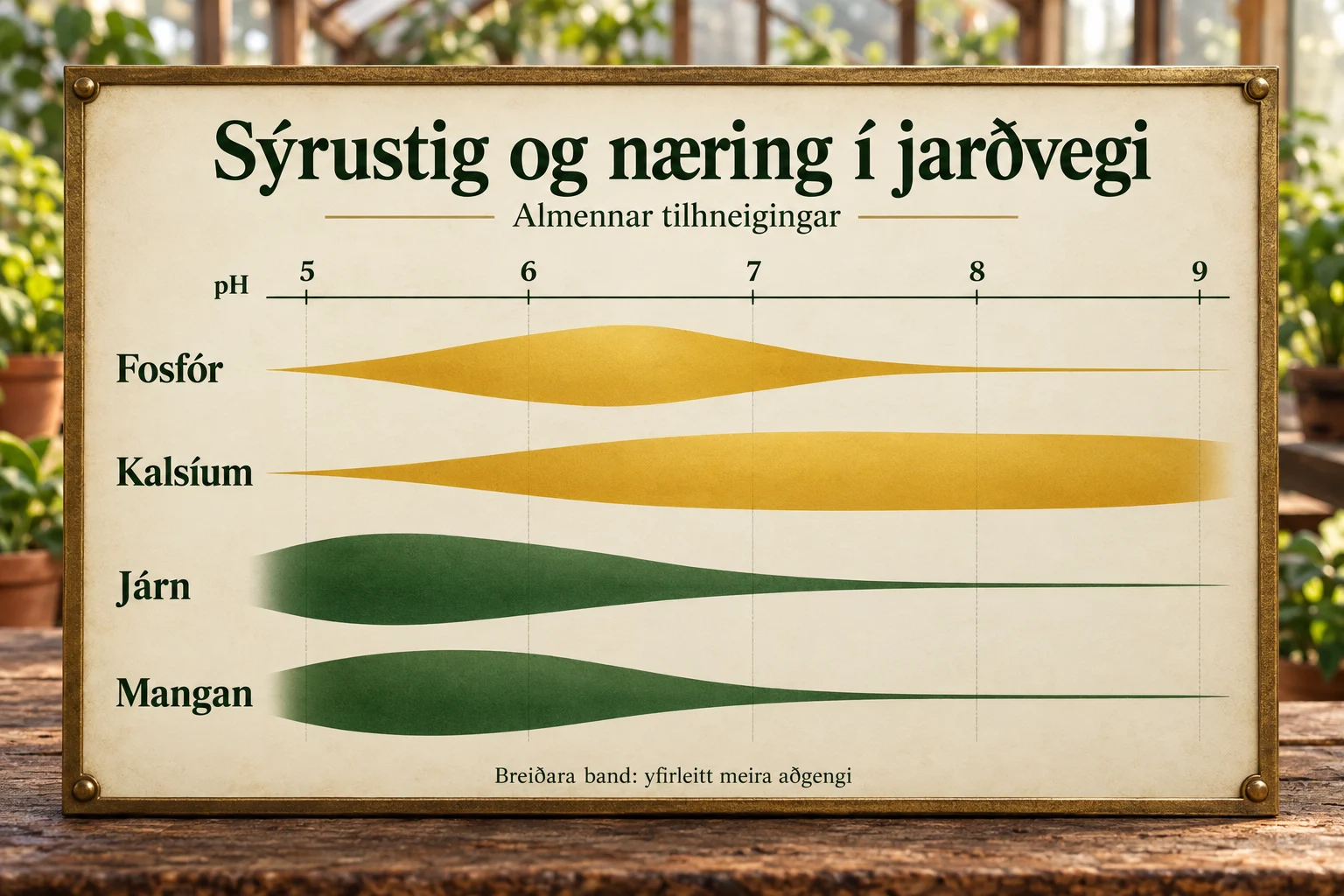
Diagram: RBHMMX · CC BY 4.0.
For many common hydroponic plants, a pH of about 5.5–6.5 is a useful starting guideline. It is not the right target for every species or growing medium. In soil, the recommendations also depend on the soil and the plant. Follow guidance for the particular crop rather than setting every plant to the same value.
Cultivated blueberries, for example, need acidic soil, often around pH 4.0–5.5, while garden lilac can grow in neutral or alkaline soil. The same acidity is therefore not suitable for every plant, and soil guidelines are not automatically guidelines for nutrient solution.
The right acidity does not automatically add missing nutrients, repair damaged roots or solve a lack of oxygen. If a plant is pale, slow-growing or wilting, also check nutrition, water, light and the root zone.
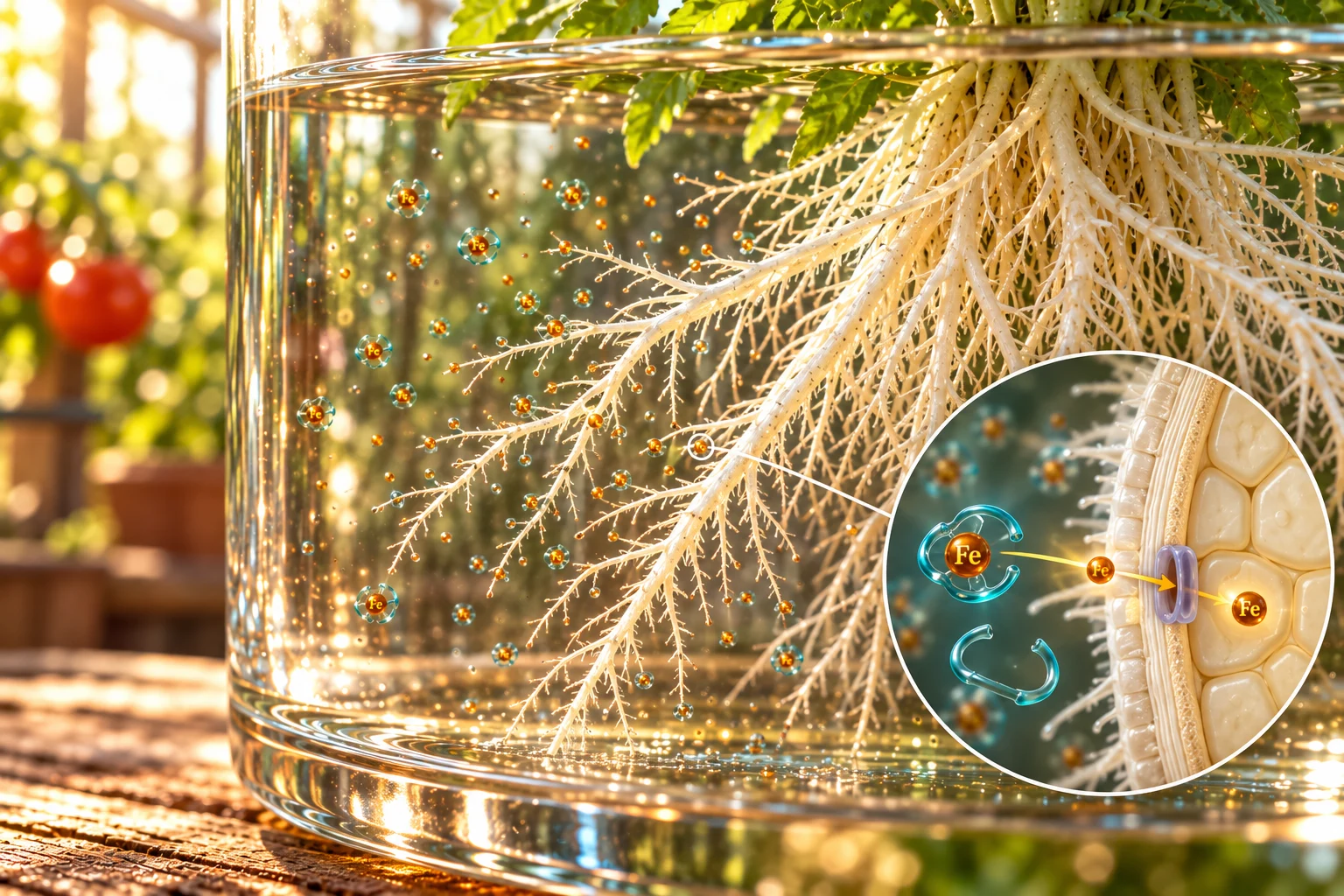
Diagram: RBHMMX · CC BY 4.0.
For the curious: EDTA, DTPA and EDDHA
These are chelating agents that can keep iron dissolved under conditions where it would otherwise tend to precipitate out of solution. Iron chelated with EDDHA generally tolerates a higher pH than iron-DTPA and iron-EDTA. This means acidity can have less effect on iron availability. It does not mean pH no longer matters for other nutrients or the roots.
Conventional nutrient-availability charts often show general trends in soil. A wider band usually means greater availability, not a measured amount or a fixed uptake rate. Soil, potting compost and nutrient solution are different conditions. Chelating agents, other substances in the solution, plant species and root health can all change the picture. Greater availability is not always better either; at low pH some substances can become too available.
That is why you need to check what the chart applies to before using it to decide on pH. Don’t transfer soil ranges directly to hydroponics or treat them as an exact dosing or diagnostic chart.
Why is pH harder to change in some water than in others?
Two buckets of water can show the same pH yet need very different amounts of pH adjuster to lower it. The water contains substances that can counteract the acid you add. So the pH reading alone does not tell you the right dose.
If pH is difficult to lower, or rises again after adjustment, the explanation may lie in the water itself. Adding more pH adjuster is therefore not always the best first step.
For the curious: what is alkalinity?
The ability of water to neutralise acid is called alkalinity. Bicarbonate, a dissolved substance in water, often plays a large part in it. pH describes the acidity measured at a given time. Alkalinity, by contrast, helps explain how much acid is needed to lower it. Water with a high pH does not necessarily have high alkalinity, and an ordinary pH meter does not measure alkalinity.
If it is difficult to keep acidity within a suitable range, a water analysis may help you find the reason. Icelandic water is not all the same. Its properties depend, among other things, on the water source and the substances dissolved in it.
Measure at the roots
In hydroponics, measure a well-mixed nutrient solution. It is useful to know the pH of your tap water, but once fertiliser has been mixed in, it is the pH of the nutrient solution that matters to the roots.
In potting compost or soil, you need to use a measurement method suited to the sample. Measuring drainage water can give a different result from a soil test. The amount of water mixed with the soil sample and the way the sample is taken can affect the reading. Compare results measured using the same method.
Colour tests can give a rough indication, but they may be difficult to read if the nutrient solution is coloured. A digital meter needs regular calibration with a special solution of known pH. It also needs cleaning and proper storage.
Calibrating the meter and measuring correctly
Before relying on the meter, you need to know that it is giving the right reading. For this, use special calibration solutions, often labelled calibration solutions or pH buffers. The bottle states the solution’s pH. Place the probe in the solution and calibrate the meter according to its instructions.
Buffer solutions at pH 4 and pH 7 are commonly used for horticultural measurements, but use the ones recommended by the meter’s manufacturer. Tap water and fertiliser solution are not substitutes for these solutions.
- Mix the solution thoroughly and take a sample in a clean container, or measure directly in a well-mixed tank.
- Rinse the probe as directed and place it in the sample to the correct depth.
- Wait until the reading on the display is stable. Check the temperature and try to measure under similar conditions each time.
- Record the pH, sample temperature, date and what has been added to the solution.
- Rinse and store the probe correctly. A glass probe generally should not be allowed to dry out or be stored in purified or distilled water. Use the storage solution specified by the manufacturer.
If the reading jumps around, takes a long time to settle or seems unbelievable, first check the probe and try fresh calibration solution. Don’t change the water in the tank until you are sure of the measurement.
For the curious: what does a meter’s temperature compensation correct?
Temperature compensation accounts for the effect of temperature on the probe’s response. It does not make the solution independent of temperature: the solution’s own pH can change as it warms or cools. Automatic temperature compensation therefore does not mean that every reading is the solution’s pH at the same temperature.
Why does pH change?
Acidity can change as the plant takes nutrients from the water. The water itself, the fertiliser and life around the roots also have an effect. Two fertilisers can therefore affect pH differently even when used in similar amounts.
For the curious: how do roots change pH?
Nitrate and ammonium are two forms of nitrogen in fertiliser. An ion is a tiny particle with an electrical charge, either positive or negative.
Nutrients enter through the roots in different forms. Potassium and ammonium, for example, are positively charged ions, while nitrate is negatively charged. As the plant takes up and processes these nutrients, it has to maintain a balance of electrical charges.
Ammonium uptake is often associated with the roots releasing hydrogen ions, H⁺, making the surrounding solution more acidic. Nitrate nutrition, on the other hand, can push pH upwards. Both ion transport and the plant’s metabolism matter. This is not a fixed one-for-one exchange system for each nutrient ion.
That is why the ratio of nitrate to ammonium in fertiliser can have a considerable effect on acidity. The effect also depends on the plant and other conditions.
In hydroponics the pH can change faster in a small tank than in a large one. Potting compost and other growing media can affect the solution in different ways. A change in pH alone therefore does not mean the plant needs more of a particular nutrient.
Do you need to measure it every day?
No, not necessarily. I have quite a lot of experience with hydroponics and generally don’t measure pH often when the plants receive suitable fertiliser at the recommended rate and nothing else seems to be causing problems. I watch the plants. If they start to look unwell, I pick up the meter as part of working out what is wrong.
For example, I have run a recirculating system with closed tanks for a whole year without needing to worry particularly about acidity. That is my experience with systems I know. When you are starting out, however, it can be very useful to measure more often, learn how the water and fertiliser behave, and see what changes over time.
There is therefore no need to make daily pH testing a rule for all home growing. Measure more often in a new or unstable system, after changes to the water or fertiliser, and when something suggests there may be a problem. An occasional measurement in a system that is doing well can also reveal a change before it becomes visible on the plants. Always measure before deciding to change the pH.
The algae I forgot about
Twice I have found that the plants were starting to look unwell and went looking for the cause. On both occasions, light reached the nutrient solution, either in a tank or in channels, and algae began to grow. The pH had risen to a high level and the plants showed signs of nutrient deficiency. I put the problem down to the algae growth and the rise in pH.
The funny thing, or perhaps a little frustrating, was that the second time I didn’t remember the first incident until I had worked out what was wrong. Then I recalled that exactly the same thing had happened before.
This is one thing worth checking when pH starts to rise unexpectedly: can light get into the tank or reach the water in the channels? Algal growth can push pH up. Blocking light from the nutrient solution helps limit the growth. If the cause is still there, simply lowering the reading won’t solve the whole problem.
For the curious: how can algae raise pH?
Algae use light for photosynthesis and take up carbon from the water, including carbon dioxide. This can change the chemical balance and raise pH. The effect depends on the water and other organisms in the system, so algae do not always raise pH in the same way. A rising pH by itself also does not prove that algae are the cause.
In a study of algae in recirculating hydroponics, photosynthesis by the algae was associated with rising pH, but other processes in the system could work in the opposite direction. This suggests a possible mechanism behind the experience described above, without being a measurement of my system.
If you need to adjust the value
First confirm the measurement. Then mix the fertiliser according to the manufacturer’s instructions, allow it to stabilise, and measure before adjusting the pH. Use a pH adjuster suitable for your growing method and follow the label instructions for handling and dosage.
Make small adjustments, mix well and measure again. Don’t pour pH adjuster directly onto the roots or mix it undiluted with concentrated fertiliser solutions that are yet to be diluted. An amount that worked in the previous tank is not automatically right for the next mix.
If you find yourself repeatedly having to make large adjustments, check the water, fertiliser and growing medium, and whether contamination or a measurement error could explain the problem. Try to keep the pH within a suitable range for the plant. Small fluctuations within that range do not always need correcting.
See also
Originally published: 23 February 2023. Last editorially reviewed: 14 October 2026.
Translated from Icelandic with AI assistance. Read the Icelandic original. Links to untranslated articles open in Icelandic.