
 Íslenska
  English
 Water pumps come in many sizes and designs, but the key question is how much water must reach its destination at the required lift height. A large flow figure on the box does not, by itself, tell you whether a pump suits your system.
Start with the growing system, then work back to the pump. Flood and drain (Icelandic article), drip irrigation and nutrient film technique have different demands. Not every hydroponic method needs a water pump: the Kratky method is one that works without one.
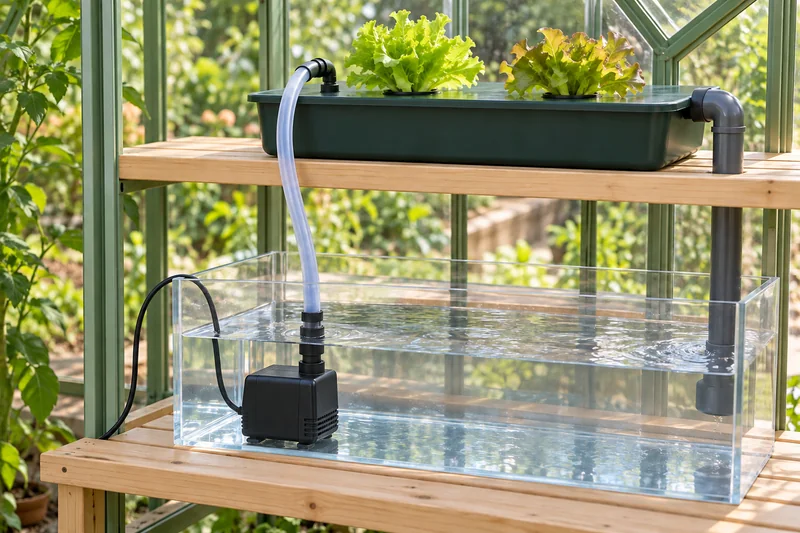
Image: RBHMMX · CC BY 4.0.
How these pumps work
You may have seen small pumps sitting at the bottom of an aquarium or water tank. Many have a small bladed wheel that spins inside. Water enters the centre of the wheel, moves towards its edge and leaves through the outlet. This is a centrifugal pump. The name is more complicated than the idea!
Another design is the diaphragm pump. A flexible membrane moves back and forth, taking water in and then pushing it out. One-way valves keep the water moving in the right direction. These pumps are used, among other things, where pressure or controlled dosing is needed; choose a model suited to the liquid and the job.
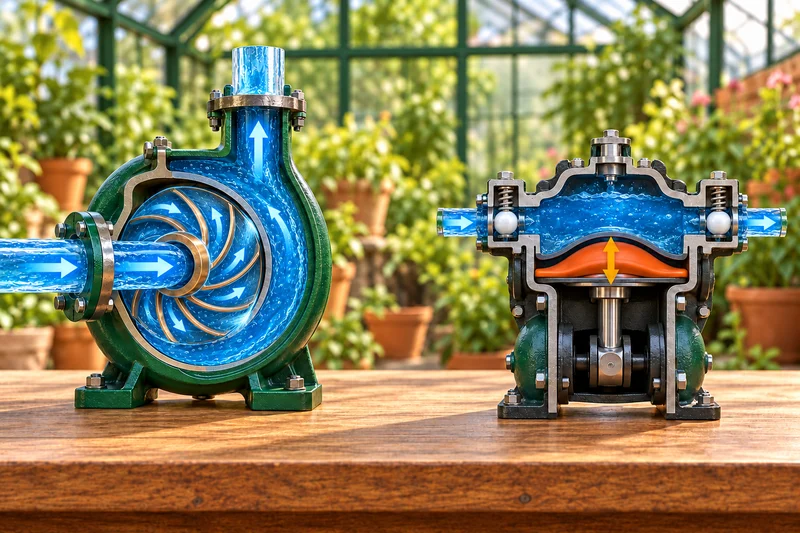
Image: RBHMMX · CC BY 4.0.
Submersible pump, on the other hand, tells you that the pump is designed to sit in water. It describes its placement, not how it works. A submersible pump can also be a centrifugal pump. Always check whether a pump may be submerged or must stand outside the reservoir.
For a simple home growing system, a small water pump that suits the tank and moves enough water up to the plants is often enough. We do not need to become pump engineers. But we do need to understand two figures on the box: flow and head.
Flow and head go together
Flow tells you how much water a pump moves in a given time. Here, litres per hour (L/h) are convenient. Head is stated in metres and describes the resistance a pump can overcome, expressed as the height of a water column.
With small impeller pumps, it is essential to read these two maximum figures correctly. They do not occur at the same time. Maximum flow is measured against little resistance; at maximum head, flow has fallen to zero. A pump marked 1,000 L/h and 2 m does not promise 1,000 litres an hour at a height of two metres. Two metres is precisely the height at which it stops delivering water.
Many pumps come with a graph showing the relationship between flow and head. Find the height your system needs and read the flow at that height. Compare that figure with the system's needs.
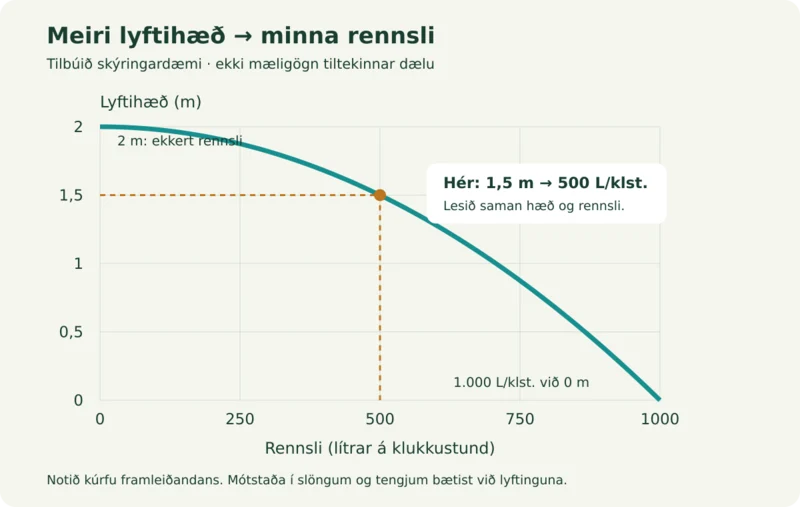
Image: RBHMMX · CC BY 4.0.
On the graph, start at the height on the left, move across to the curve and then down to the flow figure. Hoses and fittings add resistance in an assembled system. The final check is therefore to measure what actually comes out of the hose.
Measure from the water surface
In an open system with a submerged pump, vertical lift is measured from the reservoir's water surface to the point where water exits. It is not measured from the bottom of the pump. Placing the pump deep in the tank does not add that depth to the lift.
The water level can fall while pumping. In a flood-and-drain system, it helps to consider the lowest level in the reservoir as the bed fills. If the outlet sits below the water surface in another open container, the relevant height difference is measured to that container's water surface.
Resistance in hoses, bends, fittings and filters comes on top of this lift. Long or narrow pipes can reduce flow substantially. A pump curve alone therefore cannot tell you exactly what will emerge from the hose in the finished system.
A flood-and-drain example
Suppose a 100 L grow bed is filled with clay pebbles. First, measure how much water is needed to reach the intended flood level. Do not assume it will always be half the bed's volume: pebble size, packing, pots and flood height all affect it.
If measurement shows that the bed needs 50 L and we want to fill it in 15 minutes, the calculation is:
50 L ÷ 0.25 h = 200 L/h.
Those 200 L/h must actually reach the bed under operating conditions. In this example, I would aim for the bed to fill in no more than a quarter of an hour. That is a design target for this example, not a universal rule for how long every plant should be watered.
If the height from the reservoir's lowest water level to the outlet is 60 cm, the pump must deliver at least 200 L/h at that lift and against the resistance of the pipework. Figures of 40 cm for reservoir depth and 20 cm for bed depth are not, by themselves, enough to determine that height difference.
If water is also draining from the bed while it fills, the incoming flow must be greater than this simple calculation suggests. The reservoir must also hold the water that returns when the bed drains, without overflowing.
A drip irrigation example
In a drip system (Icelandic article), first establish how many emitters operate at once and how much water each delivers. These are the small outlets that drip water near each plant. Ten emitters delivering 2 L/h each need a combined 20 L/h. That is flow while the system runs, not the plants' water requirement for a whole day.
But flow alone is insufficient. The emitter's rated flow applies at a specified pressure or within a specified pressure range. A pump can have a generous maximum flow and still fail to provide the pressure the emitters need.
Examine the specifications of both pump and emitters. Then measure actual flow at nearby and distant pots. Different hose lengths, heights or blocked emitters can leave pots receiving different amounts.
Test the assembled system
A simple test often tells you more than a guess. Run water through the same hose, fittings and filter you will use for growing, at the intended height and water level. Collect it in a measuring container for a set time.
If 5 L collects in 90 seconds, the flow is:
5 L × 3,600 ÷ 90 = 200 L/h.
In a flood-and-drain system, also measure the actual filling and draining times. Check that the reservoir does not empty below the pump inlet and that overflow and drains can cope with the flow. Repeat the measurement if you change the equipment or pipework.
Noise, operation and maintenance
Noise matters indoors. You may hear the pump itself, vibration carried through the reservoir or shelf, and returning water. One general decibel figure does not tell you whether a system will be pleasant in a room. Placement and installation matter too.
Choose a pump designed for the liquid and the required duty cycle. A pump that needs to run around the clock must be made for continuous operation. Check fitting sizes, filter access and how easy the pump is to clean.
It can be worth paying a little more for a quality pump, especially if it will run often inside the home. I would consider noise, durability, warranty and spare-parts availability. Price alone does not tell the whole story. An inexpensive pump may be perfectly fine, but when little is known about its maker or quality, it is somewhat of a gamble. It may be noisy or fail earlier than hoped—or run well for years.
An inexpensive pump may also be useful as a spare. If the main pump fails, being able to swap it immediately is far better than starting to search for a replacement. Test the spare in the system in advance so you know it delivers enough water at the correct height and fits the hoses and connectors. A spare helps only when you notice the failure; it does not take over automatically.
You can calculate electricity use from actual power consumption and running time. A 20 W pump running around the clock uses 0.48 kWh per day. Multiply that by your own electricity price to estimate cost.
Watch the flow after growing begins. Roots and plant debris can block the inlet or filters. How quickly a stopped pump harms the plants depends on the system and the moisture remaining around their roots. Treat a stoppage seriously in a system whose roots rely on continuous flow.
See also
Translated from Icelandic with AI assistance. Read the Icelandic original. Links to untranslated articles open in Icelandic.