
 Íslenska
  English
 You cannot always see what is happening inside a pot. Roots support the plant and supply it with water and nutrients, but they themselves need air, moisture and a suitable temperature. When growth stalls, looking only at the leaves is not enough.
Plants differ greatly in their watering needs. Aloe vera likes its growing medium to dry well between waterings, while a tomato plant in full growth needs more even moisture and can be damaged if its entire root ball dries out. A dry surface does not mean the whole pot is dry. One watering rule cannot suit every plant.
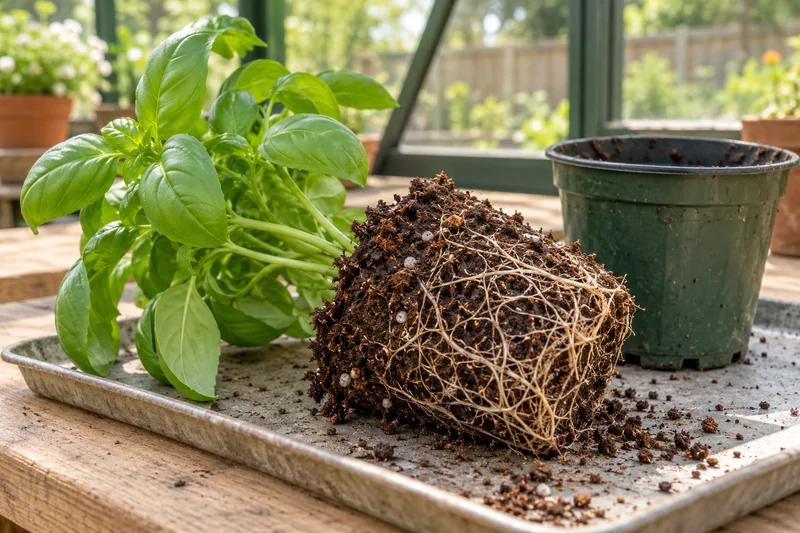
Image: RBHMMX · CC BY 4.0.
We call the material in which roots grow a growing medium. It may be soil, coir or stone wool, for example. The growing medium, pot and watering routine should suit both the plant and your conditions.
In brief
- Roots need oxygen. Waterlogged growing medium can restrict air exchange and contribute to root problems.
- Check the moisture and weight of the pot before watering instead of following a fixed calendar.
- Where hand watering is appropriate, water slowly and evenly and let the excess drain away.
- The temperature around the roots may differ greatly from room temperature.
- Potting mix and every hydroponic system do not need the same watering frequency.
Air around roots
It is easy to overwater out of concern. You do not want the plant to dry out, so you add a little water, then do it again before it needs more. If the air spaces in the growing medium remain full of water, oxygen can become scarce and the roots can be deprived of it. That can weaken and damage them and make them more vulnerable to infection. Prolonged wetness can also favour disease-causing fungi and other microorganisms that cause root rot. Damaged roots absorb water less effectively, so a plant may even look thirsty while its pot is wet.
A good growing medium holds both water and air. Particle size, compaction and the type of amendments affect that balance. Pumice and expanded perlite can increase air spaces in a suitable mix. Perlite here means the light white granules sold for growing; they are made by heating perlite rock until it expands. Coir retains moisture and can also hold air well, though its properties depend on how it is processed and how coarse it is.
Gravel, sand and clay pebbles are not interchangeable. Fine sand can compact a mix instead of aerating it, and shell sand can alter pH. Choose an amendment for its properties and for the plant, rather than merely because it is coarse or mineral. The pot also needs drainage holes that stay clear.
Root-zone temperature
Cold beside a window can slow the roots even when the rest of the room is warm. Outdoors, pots and raised beds can warm faster than the surrounding soil, but they can also cool and dry faster. Dark containers in sunlight often absorb more heat than light-coloured ones. That can help in cool weather and cause problems when the sun shines directly on them.
Warmer is not always better. The ideal temperature depends on the plant and its growth stage, and an overheated root zone can damage roots. In a nutrient solution, warm water also holds less dissolved oxygen than cooler water. Temperature and aeration therefore need to be considered together in hydroponics (Icelandic article).
Avoid sudden temperature changes when watering, especially with warmth-loving plants. Do not try to warm a cold pot with hot water. Instead, measure the temperature near the roots and adjust the position or growing conditions. For controlled seedling production, a heat mat with suitable temperature control can help, provided it matches the plant's needs.
Watering the whole pot by hand
How much the medium should dry between waterings depends on the plant and the medium. For drought-tolerant plants such as aloe, it can dry well; a growing tomato needs steadier moisture. The aim is not to dry out the roots or regularly let the plant wilt from thirst.
When it is time to water, moisten the medium slowly and evenly. If water immediately runs down the side of the pot, the centre may still be dry. Watering in two passes a short time apart may help the medium absorb it. Let excess water drain and empty the saucer under an ordinary soil-filled pot.
Drainage water can help flush accumulated salts, but it does not always have to be exactly 10% of what you applied. The need depends on the water, fertiliser, medium and growing system. Drainage water is not automatically old or oxygen-free either. If nutrients seem to be accumulating, examine your feeding routine and electrical conductivity (Icelandic article) using a measurement method suited to the sample.
Recirculation and aeration
In my recirculating systems I have tried everything from continuous flow to watering every few hours. I notice a pattern: when there is a long gap between runs, for example six hours, I tend to encounter more problems. When I run the system more often, I see fewer. My explanation is that movement and aeration help keep enough oxygen in the nutrient solution.
I have also used air stones to pump air into the water. In my systems they make more difference when there are long intervals between watering cycles. When the system runs more often, or continuously, I see little or no obvious additional benefit from the air stones. I therefore seem to get much of the benefit by running the system more frequently.
Water movement that increases contact with air can help oxygen dissolve into the water. How frequently a system needs to run still depends on its setup, the plants and the growing medium. Recirculation alone does not guarantee enough oxygen; water temperature and the roots' oxygen demand matter too. In deep water culture (Icelandic article) and other systems where roots stay submerged for long periods, aeration needs particular attention.
That is also why “roots must never stand in water” is too simple a rule. It can be useful for an ordinary pot of soil, but roots can grow in water when the system supplies the right conditions.
Space and resistance
Dense or heavily compacted soil can restrict root growth, air exchange and drainage. This may matter, for example, near paths and roads or where the soil layer is shallow. Long-standing water can likewise limit rooting depth for plants that tolerate low oxygen poorly, although species differ.
Carrots and other root vegetables benefit from a reasonably deep, loose medium without large obstacles. That does not mean every loose material works on its own. Compost, coir and potting mix differ in nutrients, water retention and weight. I have also considered stone wool for root vegetables as an experiment, but that is an idea to investigate, not a method I am claiming to have tested.
When you suspect a root problem
Check the moisture, drainage and smell of the pot. Root colour varies by species and medium, so colour alone is not a diagnosis. Soft, disintegrating roots, an unusual smell and persistent wetness warrant a closer look. More fertiliser will not repair damaged roots and may increase salt stress.
Clean containers and tools matter, especially for sowing and shared recirculating water. Diseases can spread through water and dirty equipment. First correct what you can see is wrong: blocked drainage, watering too often, cold or an unsuitable growing medium. Then watch for new growth instead of changing everything at once.
Translated from Icelandic with AI assistance. Read the Icelandic original. Links to untranslated articles open in Icelandic.