
 Íslenska
  English
 Some time ago I was deep in research—on YouTube—when I found a video of hydroponics without a pump. My first thought was that it could not possibly work. Surely someone was trying to fool people. But I watched the whole video, then several more by the same person. His other growing advice held up, so why not this?
I looked into it and found material confirming that the method was real. I would now like to introduce the Kratky method, named after B. A. Kratky at the University of Hawaii. It works by allowing the solution level to fall as the plant uses the nutrients and water.
I love gadgets and conventional hydroponics, but they do not suit every situation. Many systems need pumps, pipes, reservoirs, air stones or timers. That is wonderful for a gadget enthusiast; sometimes, though, simplicity wins.
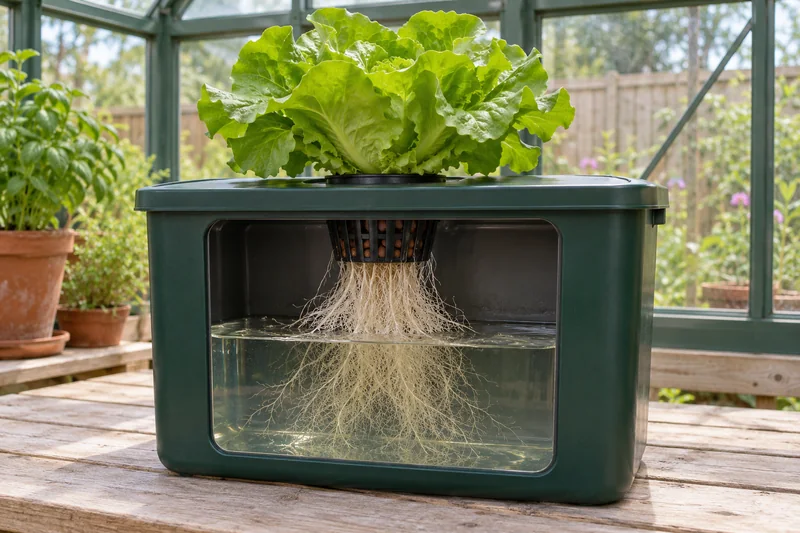
Image: RBHMMX · CC BY 4.0.
How it works
At its core, the system resembles deep water culture (Icelandic article): a plant sits in a net pot above a reservoir of nutrient solution. The difference is that Kratky uses neither a water pump nor an air pump. At first, the bottom of the pot reaches into the solution, and the growing medium draws moisture up to the young plant.
As the plant grows and takes up water, the solution level falls. Roots grow down into the solution while a humid air gap forms above it. Roots in that gap obtain oxygen from the air; the lower roots take up water and nutrients from the solution.
The air gap is therefore part of the system. It is not a sign that someone forgot to top up the reservoir.
One fill can be enough
In the simplest version, you put enough nutrient solution in the container at the start to last until harvest. Then you do not need to refill it during the crop. It hardly gets simpler than that!
That works only when the volume of solution, the plant and the growing period suit one another. Lettuce and other leafy crops with a short growing period are a useful starting point. A large tomato plant expected to produce fruit over a long period needs a very different reserve.
In Kratky's 2009 lettuce study, leaf lettuce and loose-head lettuce were generally harvested about six to seven weeks after sowing. That describes the conditions in that study; it is not a fixed recipe for an Icelandic windowsill. Light, temperature and cultivar strongly affect growth rate.
What you need
- An opaque container with a lid and enough room for nutrient solution and roots.
- A net pot or similar support to hold the plant steady.
- A growing medium that supports the young plant and carries moisture to it.
- Water and a hydroponic fertiliser that supplies all essential nutrients.
- Enough light and suitable conditions for the plant.
I would give young plants time to establish roots in their pots before moving them into the system. Look at the roots rather than the calendar: they must be able to reach the solution as its level falls.
Clean the container and mix the nutrients according to the fertiliser's instructions for that plant. Position the pot so the bottom of the growing medium is moist at first. Do not submerge the whole plant or the whole pot.
Do not submerge the air gap
Once the roots have adapted to the humid air, do not refill the reservoir to its original level and submerge them. A simple top-up could then destroy the condition that makes the method work.
If the solution is running out before harvest, add more carefully while keeping the air-breathing part of the root system above the solution. Refilling is possible with proper control of the water level; it is not the same as filling an aerated deep-water system.
Also check that some roots still reach the solution. An air gap alone is no help if the lower roots have become completely dry.
Simple still needs attention
A lid and an opaque container keep light out of the nutrient solution and help limit algae. Keep plant debris out of the solution, and check the water level and the plant regularly. For longer crops, it is useful to monitor pH and electrical conductivity instead of assuming that the solution remains unchanged.
For indoor growing in Iceland, you also need to consider light, especially in winter. The system needs no electricity for pumping or aeration, but grow lights may still need power. Kratky simplifies water delivery; the plant still needs light, nutrients and a suitable temperature.
See also
- Hydroponics (Icelandic article)
- Deep water culture (Icelandic article)
- Plant nutrition
- pH (acidity)
- Electrical conductivity (Icelandic article)
Translated from Icelandic with AI assistance. Read the Icelandic original. Links to untranslated articles open in Icelandic.