
 Íslenska
  English
 You may come across two different figures for phosphorus on the same fertiliser bag. One might say 20% and the other 8.72%. It may look as though something does not add up, but both can be right. The same amount is simply being expressed in two different ways.
The difference is whether phosphorus is counted on its own or expressed as an oxide equivalent, with oxygen included in the calculation too. Here at Plantan, I use the nutrients themselves when comparing amounts. So sometimes the figures on the bag need to be converted.
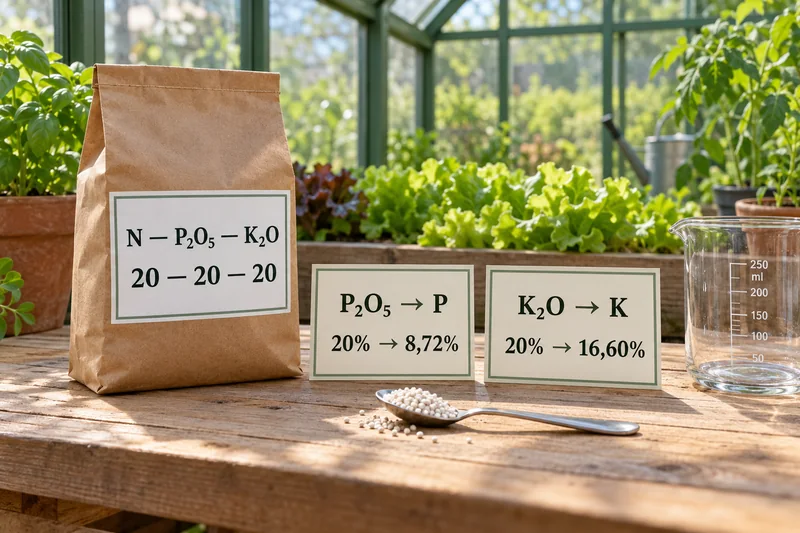
Image: RBHMMX · CC BY 4.0.
The same fertiliser, different figures
On the label, you can tell the difference from the symbols. P stands for phosphorus, as discussed in the linked article (in Icelandic), while P₂O₅ is the oxide equivalent. For potassium, the corresponding distinction is between K and K₂O. Nitrogen (N) is already given on its own and does not need this conversion.
Take a fertiliser labelled 20–20–20, where the figures stand for N, P₂O₅ and K₂O. When we count the nutrients themselves, the figures become about 20–8.72–16.60. No nutrients have been taken out of the bag. We are simply counting differently.
Does oxygen really weigh that much?
It may feel odd to think of oxygen as having weight. We cannot see it in the air, and we do not usually notice its weight. But oxygen has mass, just like any other substance.
In this example, 20 g of P₂O₅ equivalent works out at about 8.72 g of phosphorus and 11.28 g of oxygen. Oxygen therefore accounts for more than half the weight in the calculation. When we count only the phosphorus, 8.72 g remains. The amount of phosphorus has not changed.
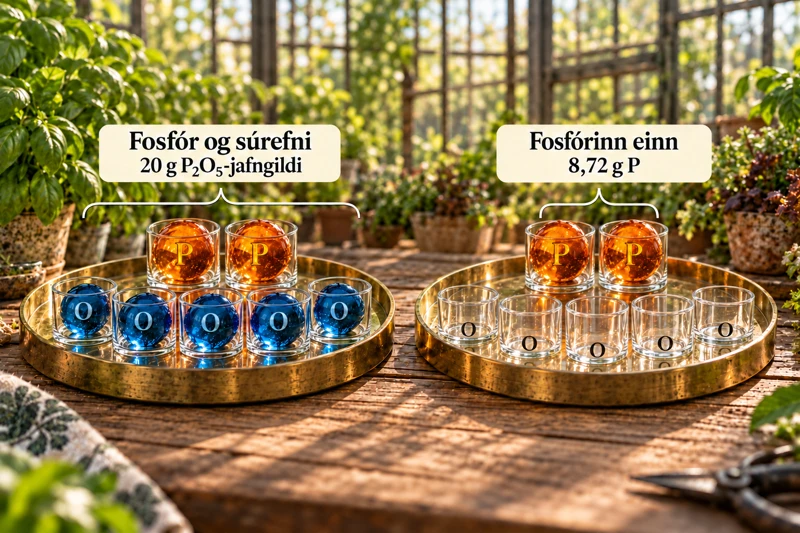
Image: RBHMMX · CC BY 4.0.
On fertiliser labels, these figures are conventionally reported as oxides, or oxide equivalents. They describe quantities; they do not necessarily tell you which compounds are actually in the fertiliser. So converting the figures does not remove oxygen from the product.
Try the converter
Enter the figures from the fertiliser label and see how the same contents are expressed the other way round. The example starts at 20–20–20.
The nutrients themselves (N–P–K)
20 – 8.72 – 16.60
More elements: calcium, magnesium and sulphur
- Ca
- %
- Mg
- %
- S
- %
Use mass percentages for the same product. The converter shows an equivalent on a different reporting basis, not how much fertiliser to use or the strength of a finished nutrient solution. The factors are rounded.
When do you need to convert?
When you are comparing figures expressed in different ways. If the instructions use P but the bag gives P₂O₅, you need to convert the figures to the same basis. The same applies to K and K₂O. If both values are already on the bag, there is no need to calculate them again.
If you simply follow the dosage instructions for your fertiliser, you usually do not need to worry about this. The converter helps you compare contents; it does not tell you how much fertiliser a plant needs. Make sure you are comparing like with like too, for example total content with total content, not with the water-soluble portion.
How is this calculated? Factors and further explanation
Multiply the oxide-equivalent value by the factor to get the amount of the element. To convert back, divide by the same factor. The factors are rounded.
| Expressed as | Conversion to element | Example |
|---|---|---|
| P₂O₅ | Conversion to element: P₂O₅ × 0.436 = P | Example: 20% P₂O₅ ≈ 8.72% P |
| K₂O | Conversion to element: K₂O × 0.830 = K | Example: 20% K₂O ≈ 16.60% K |
| CaO | Conversion to element: CaO × 0.715 = Ca | Example: 10% CaO ≈ 7.15% Ca |
| MgO | Conversion to element: MgO × 0.603 = Mg | Example: 10% MgO ≈ 6.03% Mg |
| SO₃ | Conversion to element: SO₃ × 0.400 = S | Example: 5% SO₃ ≈ 2.00% S |
The percentages here are by weight of the product. For example, 8.72% P means that 100 g of the fertiliser contains 8.72 g of phosphorus. It does not mean that the phosphorus is present as a pure element; it may be bound in compounds.
To calculate the concentration of a prepared nutrient solution, you also need the amounts of fertiliser and water. If liquid fertiliser is measured in millilitres but its contents are given as mass percentages, you need its density to convert volume to mass.
See also: Nutrition.
Translated from Icelandic with AI assistance. Read the Icelandic original. Links to untranslated articles open in Icelandic.