
 Íslenska
  English
 Plants need the right nutrients in the right balance to develop roots, leaves, flowers, seeds and a crop. Fertiliser can make up for what is missing, but more is not always better. Too much of one element can damage roots or make it harder for the plant to take up others.
This article gives an overview of plant nutrition. The article on macronutrients looks in more detail at the roles of nitrogen, phosphorus, potassium, calcium, magnesium and sulphur.
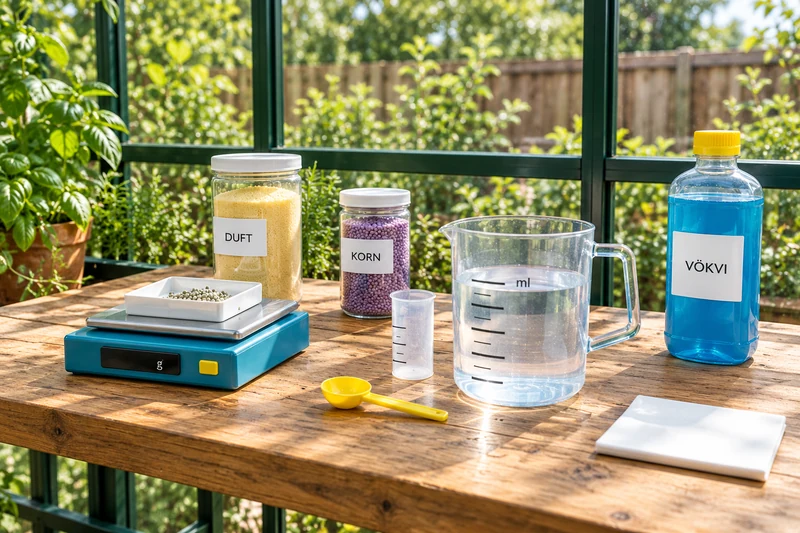
Image: RBHMMX · CC BY 4.0.
At a glance
- Plants need 17 elements to grow normally.
- Plants need a lot of some nutrients and only tiny amounts of others. Every one of them is essential.
- Roots take up most nutrients as dissolved ions from water in soil or nutrient solution.
- A suitable pH, the right concentration of nutrient solution and a healthy root zone matter just as much as what the fertiliser contains.
- Deficiency symptoms alone are rarely enough for a reliable diagnosis.
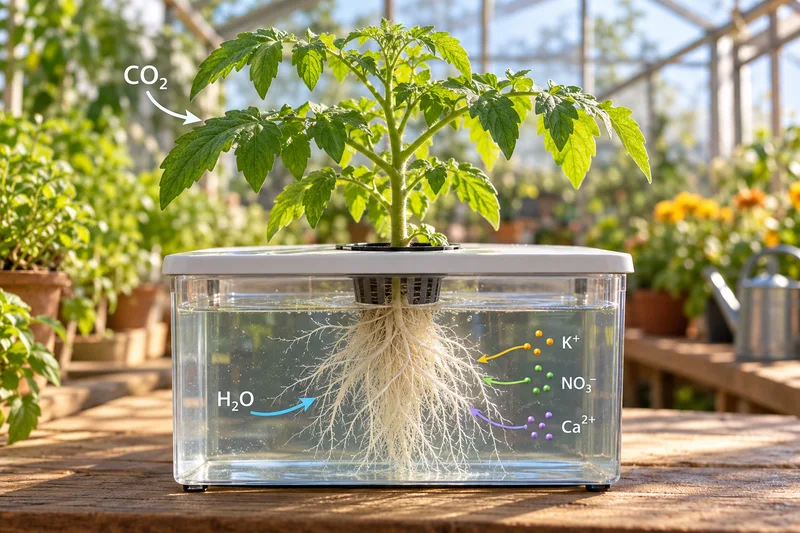
Image: RBHMMX · CC BY 4.0.
Essential plant nutrients
Carbon (C), hydrogen (H) and oxygen (O) make up most of a plant’s dry matter. Carbon comes mainly from carbon dioxide in the air, while water and air supply hydrogen and oxygen.
The other 14 essential elements come mostly from soil, growing medium or nutrient solution. They are grouped according to how much the plant needs.
| Group | Nutrients |
|---|---|
| Macronutrients most often supplied in fertiliser | Nitrogen (N), phosphorus (P) and potassium (K) |
| Other macronutrients | Calcium (Ca), magnesium (Mg) and sulphur (S) |
| Micronutrients | Iron (Fe), manganese (Mn), zinc (Zn), boron (B), copper (Cu), molybdenum (Mo), chlorine (Cl) and nickel (Ni) |
The term micronutrient simply means that the plant needs only a small amount. A micronutrient deficiency can stop growth altogether, even though the plant needs much more nitrogen or potassium.
Fertiliser packaging often puts N, P and K front and centre. That does not necessarily tell you whether the fertiliser contains enough calcium, magnesium and sulphur, or all the essential micronutrients. So choose a fertiliser suited to the growing method and the plants you are growing.
Beneficial elements are not the same as essential ones
Some elements can improve growth or stress tolerance in certain plants without being considered essential for all plants. Examples include silicon (Si), sodium (Na), cobalt (Co) and selenium (Se).
These elements are not among the 17 essential nutrients. How useful they are depends on the plant species, growing conditions and dose. An element that helps in a small amount may be useless or harmful in excess.
Salt? So can I season my food with this, then?
When we talk about salts in fertiliser, we do not just mean the table salt in the kitchen. Salt is the name for a broad class of compounds. Table salt is sodium chloride, while fertilisers may contain potassium nitrate and magnesium sulphate, for example. These supply other elements to the plant.
Some salts are also used in food. Potassium chloride, for example, is found in some salt substitutes, but a bag of fertiliser still is not a spice jar. Anything intended for food must be made for that purpose and used in an appropriate amount. Do not taste fertiliser.
When a water-soluble salt dissolves, the particles that make it up separate. These particles are called ions and carry either a positive or a negative electrical charge. Potassium nitrate, for example, releases potassium ions and nitrate ions into the water. The plant can take up potassium from the former and nitrogen from the latter. The granules disappear from view, but the elements are still in the water.
Nutrients and salts are not quite the same thing. Potassium is a nutrient, while potassium nitrate is one of the salts that can deliver it to the plant. Nor is all fertiliser made from salts: urea, for example, is another way to supply nitrogen.
How does a plant get its nutrients?
Roots take up most nutrients as dissolved ions from the water around them. They do not absorb fertiliser granules. In soil, water has to carry nutrients to the roots; in hydroponics, they are already in the nutrient solution.
In soil, nutrients are released from minerals and as organic matter breaks down. Microbes help make the nutrients in compost and organic fertiliser available. That is why the nutrients in these materials are not all ready for the plant the moment they go into the pot.
Roots are not just passive drinking straws, either. Their cell membranes contain tiny pumps and transport pathways that help move nutrients inside. Some pumps use energy to push hydrogen ions, H⁺, out of the cells. This creates electrical and concentration gradients that the plant uses when taking up nutrients.
This can also change the pH around the roots. When they release hydrogen ions, the surroundings become more acidic. Depending on which nutrients the plant takes up and how it processes them, pH can also shift the other way. The plant therefore affects the water it drinks from.
Nutrients do not all take the same route into the plant. Potassium can pass through ion channels, while nitrate, which supplies nitrogen, can enter with hydrogen ions through a different transport protein. The illustration shows these two examples. Other routes are used depending on the nutrient and the conditions.
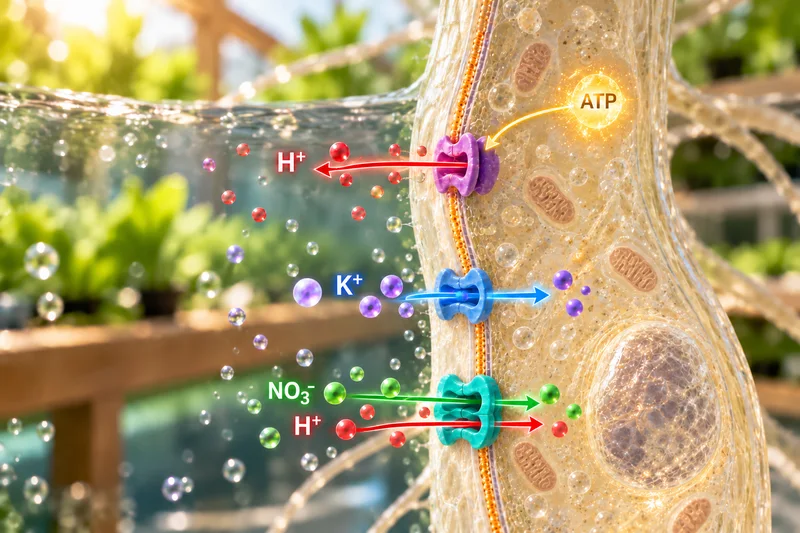
Image: RBHMMX · CC BY 4.0.
More about pumps, electrical charge and pH
The hydrogen-ion pump gets its energy from ATP, an energy-carrying molecule in the cell. It pumps H⁺ across the cell membrane, building both an electrical potential and a difference in hydrogen-ion concentration on either side of the membrane. Other transport pathways use this to move nutrients in. Potassium can enter through ion channels, for example, while nitrate uptake can be coupled with H⁺ moving into the cell.
The plant also has to balance electrical charges and pH inside its cells. If, overall, it takes up more positively charged nutrient ions than negatively charged ones, it often releases H⁺, acidifying the root zone. When negatively charged ions outweigh the positive ones in uptake, the result may be less acid around the roots and a higher pH. This is an overall balance, not a rule that every nutrient ion is exchanged for exactly one hydrogen ion.
The form of nitrogen matters here. Uptake and use of ammonium often have an acidifying effect, while nitrate can contribute to a rise in pH. Other nutrients, microbes, and the properties of the water or rooting medium also play a part. A change in pH on its own therefore does not tell you exactly which elements the plant has taken up.
Roots can also release organic acids and other compounds that affect nutrient availability in soil. This is a different process from the hydrogen-ion pump, although both can change conditions around the roots.
Most plants take up nitrogen as nitrate or ammonium. Legumes and some other plants also get help from symbiotic bacteria that fix nitrogen from the air.
Availability matters just as much as quantity
Nutrients can be present without the plant being able to use them well. pH affects which elements are available. A waterlogged, cold or poorly aerated root zone can reduce uptake. Damaged roots, a nutrient imbalance and an overly concentrated nutrient solution can also cause symptoms that resemble a deficiency.
Electrical conductivity (EC) gives an indication of the total amount of dissolved salts, but does not tell you which nutrients are in the solution or whether their proportions are right. pH also does not tell you how much nutrition is present, but it can have a major effect on its availability.
More fertiliser is not always better
Too little fertiliser can slow growth and cause a deficiency. Too much can raise the salt concentration around the roots, damage them and increase nutrient losses to the environment. A large amount of one element can also reduce the uptake of another.
It is a good idea to start with a fertiliser intended for the plants and growing method in question, and follow the manufacturer’s instructions. You can then adjust feeding to the growth stage, light, temperature and the plants’ response. If a leaf looks like a picture of a nutrient deficiency, look at other symptoms and conditions before adding a particular element. The same symptoms can have many causes.
See also
Originally published: 8 February 2023 · Last substantively reviewed: 9 October 2026
See also: Oxide equivalents or elements?.
Translated from Icelandic with AI assistance. Read the Icelandic original. Links to untranslated articles open in Icelandic.