 Íslenska
  English
 It is hard to call stone wool soil. I therefore prefer the term growing medium for the different materials in which plant roots grow. Soil, coir, clay pebbles and pumice can all do the job, although their properties vary considerably.
The growing medium needs to support the plant and give its roots access to water, oxygen and nutrients. The medium does not have to contain all the nutrients itself; in hydroponics, most come from the nutrient solution. What works in one pot may be a poor fit for another system.
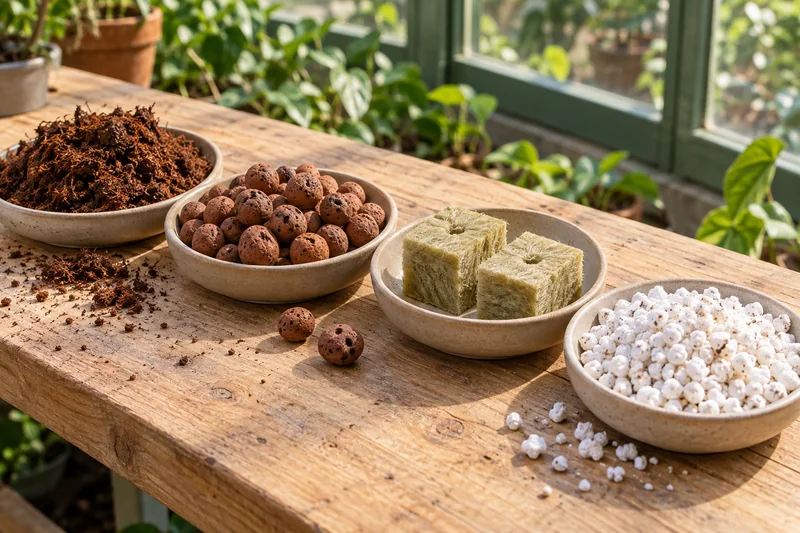
Image: RBHMMX · CC BY 4.0.
Water and air both need room
A good growing medium needs to retain enough water between waterings while letting excess water drain away and air reach the roots. Small pores tend to hold water better, while larger pores drain more readily. Once the water has drained, air can fill some of the pore spaces.
So it is not enough to ask whether a material holds a lot of water. If it stays saturated, too little air may reach the roots. At the other extreme, a medium that drains very quickly may dry out before the next watering.
Particle size, the blend and how firmly it is packed all affect this balance. The pot matters too: the same mix may stay wetter and hold less air in a shallow pot than in a taller one. Choose the growing medium and watering method together.
Active or inert?
I find it useful to start with two groups: soil and mixes where the breakdown of organic matter is an important part of nutrient supply; and materials that mainly support the roots and are fed with a solution.
That is a practical starting point, but the words “active” and “inert” do not capture every property. A material can break down slowly and still affect nutrient levels and pH. Coir is a good example: it is organic and can bind and exchange nutrient ions, even though it is often used in hydroponics.
So “soilless” does not automatically mean chemically inert. Nor does it mean that a medium will always be free of pathogens or pests. Dead roots, plant debris and microbes can build up in any of these media.
Soil and soil life
Soil is a mixture of minerals, organic matter, water and air. Fungi, bacteria and various small animals help break down plant remains. This can release nutrients in forms that plants can use.
Not all nutrients in soil are bound up in organic matter and need to be released by decomposition before they become available. Some are already dissolved in the soil water or attached to the surfaces of soil particles. Their amount and availability depend, among other things, on pH, moisture, temperature and the soil’s cultivation history.
Organic matter can improve water retention, soil structure and the soil’s ability to hold nutrients. In a garden bed, it can be useful to return well-rotted compost and healthy plant debris to the cycle. That is a different proposition from adding raw scraps to a small indoor pot or a tank of nutrient solution.
Potting compost
Bagged potting compost is usually a blend of several ingredients, such as peat, coir, bark and perlite. Blending lets manufacturers adjust how well it retains water and how much air can reach the roots. Lime and fertiliser are often added too.
Seed compost is usually a finer mix for sowing and young plants. Other mixes are intended for larger plants or specific needs, such as an airy bark mix for orchids. It is worth checking the bag to see what is in it and what the mix is for. A label that simply says “potting compost” does not tell the whole story.
Sand, clay and Icelandic soil
Rock-derived materials are not all alike. Sand, gravel and finer particles affect pore space and the weight of the bed in different ways. Weathering rock can release nutrients, but gravel or rock dust cannot be treated as a substitute for the nutrients a plant needs while growing.
Sand can be part of a growing mix, but adding a little does not always improve drainage. Fine particles can fill the gaps between larger ones and make the mix denser. Look at the properties of the whole mix rather than assuming that one amendment will solve the problem.
In Icelandic volcanic soils, allophane and other minerals can have a substantial effect on water retention and phosphorus binding. That does not mean that all Icelandic soils have the same properties, or that all phosphorus is unavailable.
Phosphorus can also build up where fertiliser has been applied regularly. Fertiliser use should therefore be based on a soil test and the needs of the crop, not simply on the fact that the soil is Icelandic or contains allophane. Phosphorus binding is a reason to check nutrient availability, not an automatic instruction to add more.
Peat materials and sphagnum
Sphagnum is a term often seen on bags of compost here in Iceland. In this context, it means sphagnum peat: partly decomposed remains of sphagnum moss that have accumulated in wetlands. This is different from living or dried long-fibre sphagnum moss, which is also sold for growing.
Sphagnum peat is an ingredient in many potting mixes. It holds water well, but can be slow to re-wet if it dries out a lot. The raw material is usually acidic and low in nutrients. Bagged compost is often amended with lime and fertiliser, and sometimes other materials such as wood fibre or perlite. So it is worth checking the ingredients, rather than relying on the word “sphagnum” on the bag.
Icelandic peat soil and imported sphagnum peat can have very different structures. Origin, degree of decomposition and particle size affect how much water and air the material holds.
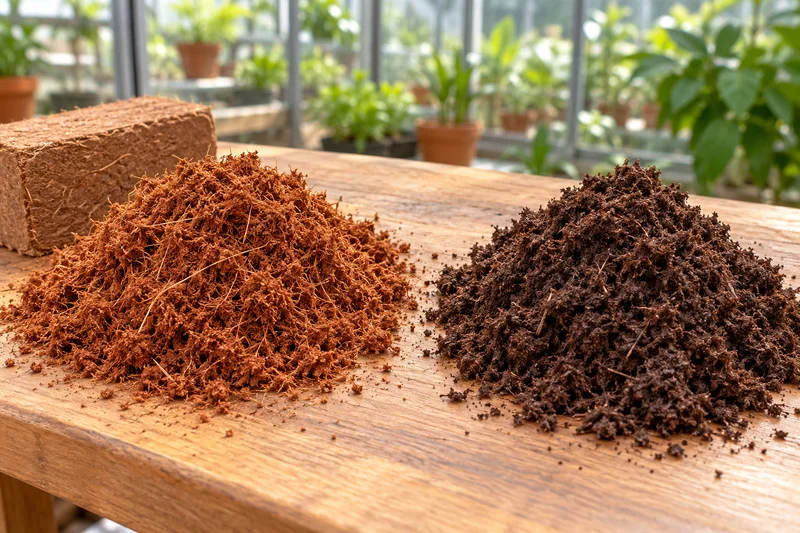
Image: RBHMMX · CC BY 4.0.
Compost
Compost is made as organic material breaks down, for example food scraps and garden waste. It is therefore a different material from peat, although both can be ingredients in a potting mix.
Well-rotted compost can be a useful amendment. Its quality depends on the materials and process used, and it can contain a fair amount of nutrients and soluble salts. Heavy applications of either fertiliser or compost can therefore raise salt levels too much.
Do not assume that undiluted compost makes good potting compost. For sowing and delicate seedlings, it is especially important that the material is mature and its salt level moderate. How much compost to include in a mix depends on its properties and what you plan to grow.
I do have one reservation about the compost people can get for free at recycling centres. I have seen quite a bit of plastic in compost like that, and I have also lived in a block of flats and seen what people put in the bins. I would personally rather use it for flowers and grass than for anything I plan to eat. For food crops, I feel more comfortable with compost I make myself, when I know what has gone into it.
This is my own choice, based on what I have seen. SORPA’s guidance, for example, says GAJA compost is suitable for vegetable gardens, while also noting that it may contain small amounts of plastic and glass within the applicable limits. It is therefore worth checking the ingredients, quality information and use instructions for the compost you get.
Stone wool
Horticultural stone wool is made by melting rock and spinning it into fine fibres. It is a fibrous material rather than foamed stone. It is sold in forms including small propagation cubes, larger blocks and growing slabs.
Stone wool can hold a lot of water and still retain air space once excess water has drained away. It is used, among other things, for propagation and drip irrigation. Watering needs depend on the product, its size and the plant; a high total pore volume does not automatically mean that the material holds little water.
Use horticultural stone wool and follow the product instructions for initial wetting and watering. Do not let it dry out uncontrollably, but do not keep it submerged either. Before reusing it, assess its condition, root debris and any disease risk; it is not enough that the material itself has kept its shape.
Clay pebbles
Clay pebbles are made by heating and expanding clay. There is plenty of pore space between the pebbles, and water drains away readily. They are therefore useful in ebb-and-flow systems and as support in net pots.
They generally hold less water in reserve than coir or many potting mixes. A break in watering can therefore become a problem quickly, depending on the plant’s size and conditions. Good drainage does not make them immune to overwatering if the medium never gets a chance to drain.
I find that water runs through them rather freely with drip irrigation. In that setup, I have seen roots grow best at the bottom of the pots, where it is dampest, rather than evenly throughout the medium. That is my judgement from this particular setup; water distribution also depends on the drippers, pot and watering regime.
The pebbles are loose, so a large plant may need separate support. They can often be cleaned and reused, but remove old roots and check their condition before starting a new crop. Do not add phosphorus automatically just because you are using new clay pebbles.
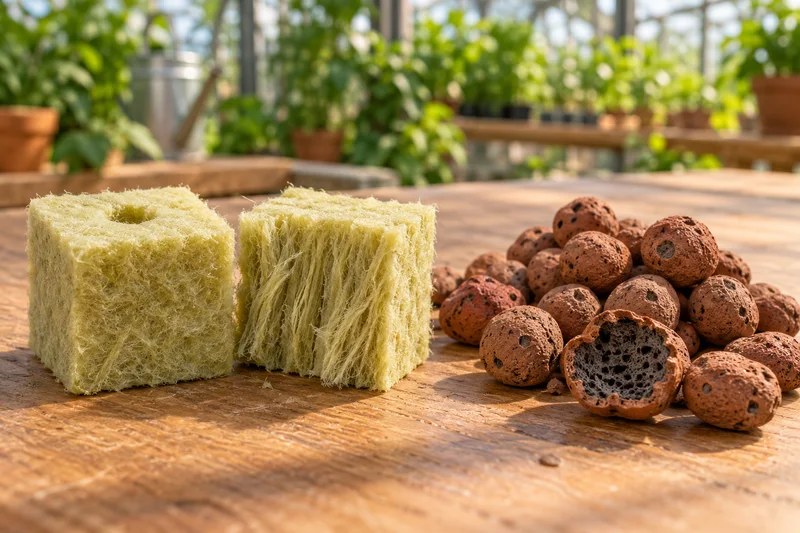
Image: RBHMMX · CC BY 4.0.
Coir
I am very fond of coir. It holds water well and wets easily. That is a handy combination, especially when you want the growing medium to have some water in reserve.
Horticultural coir is made from coconut husk and can contain varying proportions of fine particles, fibres and coarser pieces. It is sold loose and in compressed blocks that need wetting before use. Quality and structure can vary widely.
Coir is not chemically inert. It can contain high levels of potassium, sodium and other salts, and it has cation-exchange capacity: the ability to hold and exchange positively charged ions. Processing therefore matters, especially whether the product has been washed and treated for growing.
Check the instructions to see whether the material needs rinsing or other preparation, and whether nutrients have already been added. Washed material is not necessarily ready for every nutrient solution. Calcium and magnesium need to be balanced with the feeding plan, but do not add them or iron blindly.
Coir can provide a good balance of water and air, but it too can become too wet. Fine material, compaction and poor drainage change conditions around the roots. The fact that it wets easily is no guarantee of enough oxygen if the pot is standing in water.
Coir can also be loose to start with. Avoid blasting a hole in the surface with a strong jet of water. In a recirculating system, keep loose particles away from pumps and narrow pipes too.
In my experience, coir is the best growing medium for germinating seeds and rooting cuttings. I have found it easy to move young plants out of the loose material with the roots still attached. Take care and support the root system; do not tug hard on the stem.
I have not noticed mould on the coir in this use. That is my experience, not a guarantee that coir cannot carry infection or that young plants will never develop fungal disease. Hygiene, moisture and ventilation still matter.
Bark
Bark is used, among other things, in mixes for orchids. Coarse pieces leave plenty of space for air, and water runs easily between them. Finer bark generally retains more moisture and is also used in various potting mixes.
Piece size therefore matters. A coarse mix may suit roots that need plenty of air, but it can also dry out quickly. Choose bark intended for horticultural use. It gradually breaks down and becomes finer and denser, so keep an eye on it if the plant has been in the same pot for a long time.
Pumice and perlite
Pumice and perlite are not the same material, although both are light and porous. Pumice is a natural volcanic rock. Horticultural perlite is made by heating and expanding volcanic glass.
I would not grow in pure perlite. I find it too light, and the plants become unstable when disturbed. I could more readily live with pure pumice.
Both materials are used to alter the properties of growing mixes, including aeration. How much to add depends on particle size, the base mix and watering. Not every bag of pumice or perlite will give exactly the same result.
I have mixed pumice into coir myself with good results. I do not think it is necessary in every case, though; there should be a reason for adding it, such as the properties of the pot or the instructions for the watering system in question.
With a pure, coarse material, frequent watering may be needed. An automatic system can then be very useful, but you cannot set the frequency based on the word “pumice” alone. Watch how quickly the medium dries in the conditions you actually have.
Vermiculite
Vermiculite is a light mineral expanded by heating. It holds water and nutrients well, and is sometimes mixed into seed compost or coir when you want to keep moisture more even around small roots.
It is easy to confuse it with perlite, but they do not quite serve the same purpose. Perlite is often added to a mix to increase aeration, while vermiculite is more often used to retain moisture. If a pot already takes a long time to dry, adding vermiculite may not be a good idea.
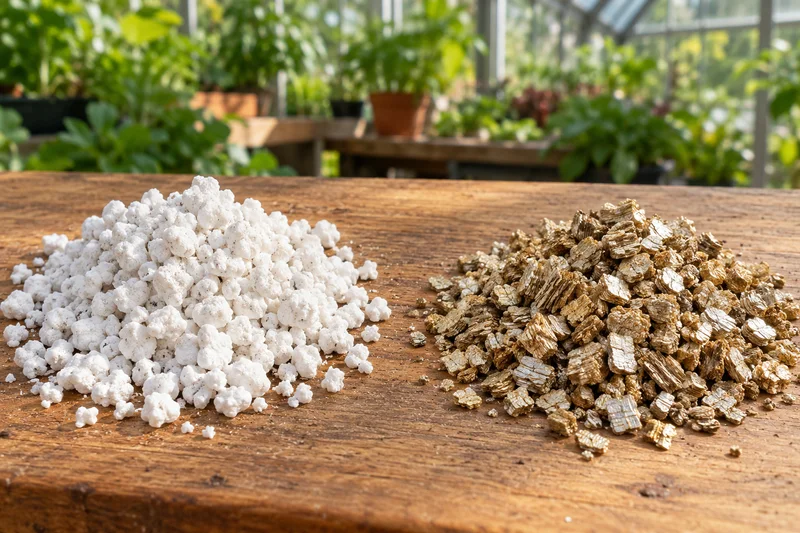
Image: RBHMMX · CC BY 4.0.
Gravel
Gravel can be used as a growing medium, including in aquaponic beds. Coarse material with few fine particles can let water flow through freely. Its weight can help support plants, but the bed needs a structure strong enough to carry it.
You do need to know what kind of rock the gravel comes from. Some gravel can affect the water’s pH and chemical composition. Choose clean material that suits the system, and do not assume all gravel is neutral just because it looks like stone.
Choose the medium and watering together
Start with what the plant and setup need. If you water by hand, the reserve of water between waterings matters a lot. An automatic system can use a faster-draining material, but the water must reach the roots and the system must be reliable.
Test a new mix in the pot you intend to use. Check how it wets, whether water drains away and how quickly it dries. In a nutrient-solution system, also monitor pH and electrical conductivity (EC), both at the start and as roots and nutrients change the conditions over time.
Indoors, natural daylight depends on latitude, season and window orientation, while temperature also affects growth. The same watering routine that works in bright conditions can leave a pot too wet when growth slows. A lamp-only set-up is less dependent on location, but watering still needs to follow the conditions and the plant’s growth. The name of the material is a useful starting point; how it behaves in your own growing setup determines what to do next.
See also
Translated from Icelandic with AI assistance. Read the Icelandic original. Links to untranslated articles open in Icelandic.