
 Íslenska
  English
 People often ask me what is good to grow indoors. I usually answer with another question: What would you eat? Growing something that regularly ends up on your plate is much more fun than choosing a plant just because it fits on the windowsill.
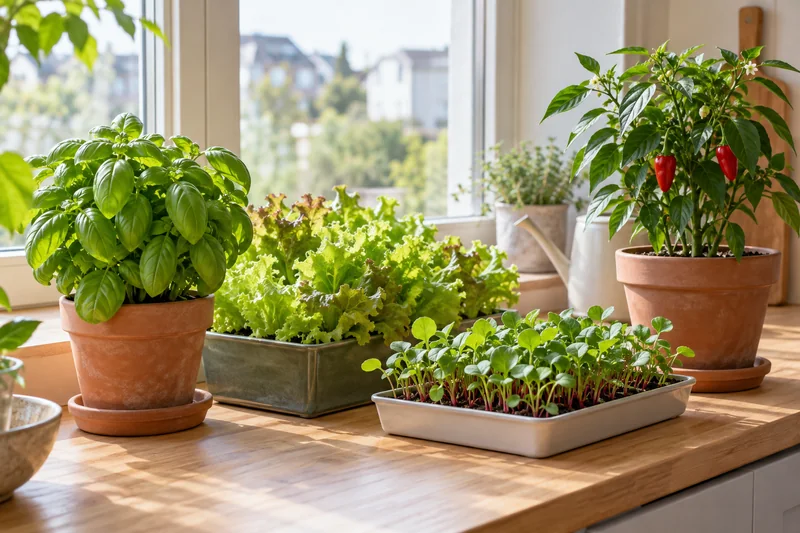
Image: RBHMMX · CC BY 4.0.
I often hear people say they kill every plant they own. Sometimes the plant gets too much water, sometimes too little, and light matters too. But I think we often overlook interest. If a plant just stands in a corner and nothing much seems to happen, it is easy to forget it. Waiting for the next monstera leaf may not be the most exciting first project.
That is why I like herbs and lettuce as a starting point. In good conditions you can see changes from day to day: new leaves appear and the plant grows. You have a reason to check on it. Then the reward regularly reaches your plate. A few basil leaves in dinner or lettuce you picked yourself make this a different project from simply remembering to water a pot.
In brief
- Start with what you use in the kitchen, then choose a plant to suit your light and space. Check its cultivar too: that is the named variety on the seed packet or plant label.
- You can pick leaves from herbs and lettuce without waiting for flowers or ripe fruit.
- Tomatoes and peppers need more light and usually more room than a small pot of herbs.
- A bright window in summer and that same window in midwinter offer very different growing conditions.
- A few healthy plants make a good start. You can always add more once you know how they grow.
Basil and other herbs
Of the herbs, I particularly recommend basil. It grows quickly with good light and warmth, tastes good straight from the plant and can be dried for storage. There are also many flavours to explore. That alone may be reason enough to try more than one cultivar.
Mint is another enjoyable plant. Not everyone uses it as often, but being able to pick fresh mint for a drink is lovely. Give it its own pot so it has room. Thyme, rosemary, lemon balm and coriander are also worth considering, though they differ in growth and care.
Not every herb needs the same watering. Mint and basil, for example, do poorly if left dry for a long time, while thyme and rosemary need excess water to drain away and should not stay constantly wet. Use pots with drainage holes and empty water collected in saucers. If you put several herbs in one container, group them by similar needs rather than appearance alone. The Icelandic herb guide has more on individual plants.
Lettuce you will use
When I grow lettuce at home, I eat considerably more of it, simply because there is always something to pick. That is a good reason to make room for it.
Decide whether you want to pick young leaves or grow a full head. Lettuce harvested young can be grown more densely and picked sooner; larger plants need more space for both roots and leaves. Do not assume every kind of lettuce will fit the same small pot. With suitable cultivars, you can pick outer leaves, or sow small batches at intervals so that everything is not ready on the same day.
Heat and drought can make lettuce bitter and encourage it to form a flower stalk, a process called bolting. My own answer to the flavour problem has been feta cheese on the salad. That is a kitchen trick, of course, not a fix for the growing conditions. If the leaves turn bitter, check the temperature, watering and whether the plant has begun to flower.
Peppers and chillies
Peppers and chillies can be rewarding indoor crops. I particularly suggest looking at cultivars that produce small peppers or chillies. I prefer having something to pick more often rather than waiting for a few large peppers. That is my preference; the rate at which fruit ripens also depends on the cultivar and conditions.
Small fruits do not necessarily mean a small plant. Check its mature size before choosing a cultivar for the windowsill. A pepper plant needs both enough light and time to crop. A good south-facing window can help during the brighter part of the year, but active winter growing usually needs additional lighting. See the Icelandic pepper guide for more.
Tomatoes need space
Tomatoes can be a good indoor project if you have sufficient light and room. For a small space, choose a compact cultivar intended for pots. An ordinary tall tomato plant may quickly outgrow its allotted space; small tomatoes alone tell you nothing about the final size of the plant.
Allow access for watering, supports where needed and space around the leaves. Indoors, you also need to consider pollination. A tomato flower can fertilise itself, but the pollen must be released inside the flower. Gently shaking the flower clusters can help where wind or insects are absent.
Microgreens for a short crop
Microgreens are young edible plants cut above the growing medium. They can make a satisfying crop in a small tray: radish and rocket are two examples. They are not quite the same as sprouts eaten with their seeds and roots.
Use seeds intended for this purpose, clean containers and clean growing medium. After germination, the plants need light, moisture and air movement; a dark corner does not become suitable just because the crop is short. Follow directions for the species and sow another tray for the next harvest instead of assuming that every species will regrow after cutting.
Light shapes your choices
A plant may survive beside a window without producing many edible leaves or fruits. Keeping it alive is different from growing it for a harvest. In Iceland, daylight changes so much over the year that success in summer does not show what the same spot can produce in December.
Additional lighting opens up more possibilities. Choose a light for the growing area, its coverage and the plants' needs rather than relying on one general wattage figure. The light must reach the leaves without scorching them. The lighting guide explains more.
Begin with a small project you want to do. If the basil goes into dinner, the mint into a drink and the lettuce onto your plate, your growing is already producing something that matters.
Translated from Icelandic with AI assistance. Read the Icelandic original. Links to untranslated articles open in Icelandic.